Ebook Download His Bloody Project: Documents Relating to the Case of Roderick Macrae (Man Booker Prize Finalist 2016), by Graeme MaCrae Burnet
The benefits to take for reading the e-books His Bloody Project: Documents Relating To The Case Of Roderick Macrae (Man Booker Prize Finalist 2016), By Graeme MaCrae Burnet are involving boost your life quality. The life quality will certainly not only regarding just how much understanding you will obtain. Also you read the fun or amusing books, it will help you to have enhancing life quality. Feeling enjoyable will certainly lead you to do something completely. Additionally, the publication His Bloody Project: Documents Relating To The Case Of Roderick Macrae (Man Booker Prize Finalist 2016), By Graeme MaCrae Burnet will offer you the lesson to take as a good need to do something. You could not be pointless when reviewing this book His Bloody Project: Documents Relating To The Case Of Roderick Macrae (Man Booker Prize Finalist 2016), By Graeme MaCrae Burnet
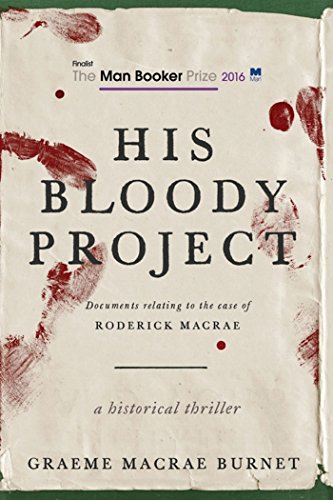
His Bloody Project: Documents Relating to the Case of Roderick Macrae (Man Booker Prize Finalist 2016), by Graeme MaCrae Burnet

Ebook Download His Bloody Project: Documents Relating to the Case of Roderick Macrae (Man Booker Prize Finalist 2016), by Graeme MaCrae Burnet
When you are rushed of task deadline and also have no suggestion to obtain motivation, His Bloody Project: Documents Relating To The Case Of Roderick Macrae (Man Booker Prize Finalist 2016), By Graeme MaCrae Burnet book is one of your remedies to take. Schedule His Bloody Project: Documents Relating To The Case Of Roderick Macrae (Man Booker Prize Finalist 2016), By Graeme MaCrae Burnet will certainly give you the right source and also thing to obtain inspirations. It is not just concerning the tasks for politic company, management, economics, as well as other. Some ordered tasks making some fiction your jobs also require motivations to get over the task. As what you require, this His Bloody Project: Documents Relating To The Case Of Roderick Macrae (Man Booker Prize Finalist 2016), By Graeme MaCrae Burnet will probably be your choice.
Just how can? Do you assume that you don't need sufficient time to opt for buying publication His Bloody Project: Documents Relating To The Case Of Roderick Macrae (Man Booker Prize Finalist 2016), By Graeme MaCrae Burnet Never ever mind! Merely sit on your seat. Open your gizmo or computer and also be online. You can open or visit the web link download that we offered to obtain this His Bloody Project: Documents Relating To The Case Of Roderick Macrae (Man Booker Prize Finalist 2016), By Graeme MaCrae Burnet By through this, you could obtain the online e-book His Bloody Project: Documents Relating To The Case Of Roderick Macrae (Man Booker Prize Finalist 2016), By Graeme MaCrae Burnet Reading the publication His Bloody Project: Documents Relating To The Case Of Roderick Macrae (Man Booker Prize Finalist 2016), By Graeme MaCrae Burnet by on-line can be truly done easily by waiting in your computer system and also kitchen appliance. So, you could continue every single time you have spare time.
Reviewing the book His Bloody Project: Documents Relating To The Case Of Roderick Macrae (Man Booker Prize Finalist 2016), By Graeme MaCrae Burnet by online can be also done quickly every where you are. It seems that waiting the bus on the shelter, waiting the list for queue, or other areas feasible. This His Bloody Project: Documents Relating To The Case Of Roderick Macrae (Man Booker Prize Finalist 2016), By Graeme MaCrae Burnet could accompany you in that time. It will certainly not make you really feel weary. Besides, through this will likewise enhance your life top quality.
So, simply be right here, discover guide His Bloody Project: Documents Relating To The Case Of Roderick Macrae (Man Booker Prize Finalist 2016), By Graeme MaCrae Burnet now and review that promptly. Be the first to review this publication His Bloody Project: Documents Relating To The Case Of Roderick Macrae (Man Booker Prize Finalist 2016), By Graeme MaCrae Burnet by downloading and install in the link. We have a few other books to read in this website. So, you could find them likewise easily. Well, now we have actually done to provide you the very best publication to review today, this His Bloody Project: Documents Relating To The Case Of Roderick Macrae (Man Booker Prize Finalist 2016), By Graeme MaCrae Burnet is really suitable for you. Never neglect that you require this publication His Bloody Project: Documents Relating To The Case Of Roderick Macrae (Man Booker Prize Finalist 2016), By Graeme MaCrae Burnet to make better life. On the internet publication His Bloody Project: Documents Relating To The Case Of Roderick Macrae (Man Booker Prize Finalist 2016), By Graeme MaCrae Burnet will really offer very easy of everything to check out and take the benefits.
MAN BOOKER PRIZE FINALIST
NAMED A BEST BOOK OF 2016 BY NEWSWEEK, NPR, THE GUARDIAN, THE TELEGRAPH, AND THE SUNDAY TIMES
A NEW YORK TIMES EDITORS’ CHOICE
"THOUGHT PROVOKING FICTION"—THE NEW YORK TIMES BOOK REVIEW
A brutal triple murder in a remote Scottish farming community in 1869 leads to the arrest of seventeen-year-old Roderick Macrae. There is no question that Macrae committed this terrible act. What would lead such a shy and intelligent boy down this bloody path? And will he hang for his crime?
Presented as a collection of documents discovered by the author, His Bloody Project opens with a series of police statements taken from the villagers of Culdie, Ross-shire. They offer conflicting impressions of the accused; one interviewee recalls Macrae as a gentle and quiet child, while another details him as evil and wicked. Chief among the papers is Roderick Macrae’s own memoirs where he outlines the series of events leading up to the murder in eloquent and affectless prose. There follow medical reports, psychological evaluations, a courtroom transcript from the trial, and other documents that throw both Macrae’s motive and his sanity into question.
Graeme Macrae Burnet’s multilayered narrative—centered around an unreliable narrator—will keep the reader guessing to the very end. His Bloody Project is a deeply imagined crime novel that is both thrilling and luridly entertaining from an exceptional new voice.
- Sales Rank: #387 in eBooks
- Published on: 2016-10-04
- Released on: 2016-10-04
- Format: Kindle eBook
Review
"It’s only a story ― or is it? Graeme Macrae Burnet makes such masterly use of the narrative form that the horrifying tale he tells in HIS BLOODY PROJECT, a finalist for this year’s Man Booker Prize, seems plucked straight out of Scotland’s sanguinary historical archives."―Marilyn Stasio, The New York Times Book Review
"Thought-provoking fiction."―The New York Times Book Review, Editors' Choice
“[A] powerful, absorbing novel… Fiction authors from Henry James to Vladimir Nabokov to Gillian Flynn have used [an unreliable narrator] to induce ambiguity, heighten suspense and fold an alternative story between the lines of a printed text. Mr. Burnet, a Glasgow author, does all of that and more in this page-turning period account of pathos and violence in 19th-century Scotland… [A] cleverly constructed tale… Has the lineaments of the crime thriller but some of the sociology of a Thomas Hardy novel.”―Tom Nolan, Wall Street Journal
“. . . recalls William Styron’s The Confessions of Nat Turner in the way it portrays an abused people and makes the ensuing violence understandable. . . Bloody Project shows that the power held by landowners and overseers allowed cruelties just like those suffered by the Virginia slaves in Confessions. Halfway between a thriller and a sociological study of an exploitive economic system with eerie echoes to our own time, His Bloody Project is a gripping and relevant read.” ―Newsweek
“Burnet is a writer of great skill and authority . . . few readers will be able to put down His Bloody Project as it speeds towards a surprising (and ultimately puzzling) conclusion.”―Financial Times
“His Bloody Project is an ingenious, artful tale of a 19th century triple murder in the Scottish Highlands. Though a novel―and shortlisted for the Man Booker Prize―it masquerades as the tale of a true crime, made up of a collection of historical documents supposedly unearthed by the writer, each bit shedding further light on what drove a 17-year-old to kill three people―including an infant―in his small crofting community.”―NPR
“. . . an intricate, interactive puzzle, a crime novel written, excuse my British, bloody well.”―Los Angeles Times
"A stellar crime novel and a wrenching historical portrait, HIS BLOODY PROJECT also succeeds at lyrically questioning whether it's possible to know another man's mind--or even desirable. The novel sends out vines in all directions, its characters' tangled motives obscured by tragedy and lies."―Lyndsay Faye, author of Gods of Gotham
“A thriller with a fine literary pedigree . . . His Bloody Project” offers an intricate, interactive puzzle, a crime novel written, excuse my British, bloody well.”―Steph Cha, Los Angeles Times
“It [His Bloody Project] had such an engrossing plot that I couldn’t put it down once I started reading it, so it was no surprise that Graeme Macrae Burnet’s excellent work was short listed for the Man Booker Prize . . .The interesting and innovative structure used by the author, where you feel like you are reading original historical records, sets the book apart from others of a similar genre and his skillful writing means the reader can’t help but empathise with the ‘murderer’. In addition to the gripping story, the book gives the reader a fascinating insight into Highland life at the time – its harshness, poverty and brutality. Definitely one of the best books this year.”―First Minister of Scotland, Nicola Sturgeon
“Clever and gripping”―Library Journal, starred review
"Psychologically astute and convincingly grounded in its environment . . . a fine achievement.”―The National
“Fiendishly readable . . . A psychological thriller masquerading as a slice of true crime. . . The book is also a blackly funny investigation into madness and motivation.”―The Gaurdian
“. . .sly, poignant, gritty, thought-provoking, and sprinkled with wit.”―Publishers Weekly, starred review
“I disappeared inside the pages of Graeme Macrae Burnet’s His Bloody Project. . . fascinating”―The Seattle Times
“Burnet has created an eloquent character who will stick with you long after the book is read.”―The Seattle Review of Books
“Both a horrific tale of violence and a rumination on the societal problems for poor sharecroppers of the era.”―TIME
“One of the most convincing and engrossing novels of the year.”―The Scotsman
“A truly ingenious thriller as confusingly multilayered as an Escher staircase”―Daily Express
“There is no gainstaying the ingenuity with which Burnet has constructed his puzzle. . ."― The Telegraph
“A masterful psychological thriller”―Ian Stephen, author of A Book of Death and Fish
“A gripping crime story, a deeply imagined historical novel, and gloriously written – all in one tour-de-force of a book. Stevensonian – that’s the highest praise I can give.”―Chris Dolan, Sunday Herald, Books of the Year
“Masterful, clever and playful . . . one of the most experimental and assured authors currently writing in Scotland”―Louise Hutcheson, A Novel Bookblog
“One of the most enjoyable and involving novels you’ll read this year”―Alistair Braidwood, cots Wha Hae
“Presented as a collection of “Documents Relating to the Case of Roderick Macrae,” which took place in 1869, the novel includes the jailhouse memoir of a 17-year-old Scottish Highlander being held in Inverness Castle, awaiting trial for three appalling murders.
"It’s only a story ― or is it? Graeme Macrae Burnet makes such masterly use of the narrative form that the horrifying tale he tells in HIS BLOODY PROJECT, a finalist for this year’s Man Booker Prize, seems plucked straight out of Scotland’s sanguinary historical archives. Roderick and his family brave feudal conditions, toiling as tenant farmers on a small allotment, harvesting peat for fuel and scavenging seaweed to fertilize their gardens. It’s a hard existence, made even harder by Lachlan Mackenzie, a vindictive constable who systematically strips the Macraes of their livelihood. When father and son bravely take their grievances to the factor, the man charged with running the estate on behalf of the laird, he cruelly dismisses their request to see the regulations they’re accused of violating. “The reason you may not ‘see’ the regulations is because there are no regulations,” he informs them. “You might as well ask to see the air we breathe.”
After being goaded beyond endurance, Roderick seeks out his tormentor while carrying a croman (a pickax) and a flaughter (a pointed spade), “merely to discover what would happen if I paid a visit to his house thus armed.” At moments like this, we begin to suspect that Roderick isn’t the most trustworthy of narrators.
For a “semiliterate peasant,” he has recorded a testament so “sustained and eloquent” that the Edinburgh literati suspect a hoax. Not so Roderick’s lawyer, Andrew Sinclair, who marvels at the prisoner’s graceful writing and command of language even as he’s sickened by the conditions under which people like the Macraes must toil. But the lawyer’s defense may not be enough to counter the contemptuous testimony of men like the bigoted prison surgeon, J. Bruce Thomson, who contributes his own sour observations to the medical reports and witness statements presented in court. Thomson’s examination of the prisoner confirms his view that criminal behavior is determined by heredity. In Macrae’s case, though, what might be inherited is sheer desperation."―Marilyn Stasio, The New York Times Book Review
About the Author
Graeme Macrae Burnet has established a reputation for smart and literary mystery writing with his highly praised first novel, The Disappearance of Adele Bedeau, which was featured in the List’s Top Scottish Books of 2014. He was born and brought up in Kilmarnock and has lived in Prague, Bordeaux, Porto, and London. He now lives in Glasgow, Scotland.
Most helpful customer reviews
99 of 107 people found the following review helpful.
A fascinating read
By DLB
4.5 stars. I first became aware of this book when the Man Booker long list was announced. I would like to try to read as many of them as possible and started with this one. For the first two thirds of the book, I wasn't quite sure why it was nominated for such a prestigious award. It was thoroughly enjoyable and I would have highly recommended it for that reason alone. It also provided an interesting twist on the crime novel in that it is written entirely in document form - police interviews with the villagers who knew the murder victims and the accused, medical examiner reports, a memoir purportedly written by the accused, an account by a preeminent criminal psychologist who interviewed the accused, his father and villagers and, finally, a report of the trial. The author also managed to write all of these various documents in voices that were true to the period. There were also interesting insights into classism, family dynamics, and the dynamics between residents in a small village.
Then the last third of the book happened and I was blown away. Those bits of the story that had niggled at your brain from earlier on that weren't properly addressed came into play. One is left with questions regarding the justice system, the death penalty and criminal insanity - particularly, in this instance, the diagnosis of it and what it would mean for the individual (either hanging or a life, likely spent in an asylum). Class issues are raised in this section as well. It was here that I really saw what the Man Booker judges did as well as gained a better appreciation of the earlier parts of this book. This doesn't mean that I feel it should necessarily win the prize (I won't make any such determination yet), but I can see why it was nominated.
This review may seem spoilerish, but I was careful to make sure that it isn't. I haven't included any information that one can't glean from the blurb, the table of contents or the first few pages. Now, stop reading this review and go read this book!
23 of 24 people found the following review helpful.
Long Bleak Grey Road Leading to Disappointment
By Leigh Podgorski
This, alas, joins a long list of disappointing books I have read with initial eager anticipation from the Man Booker prize winners. I downloaded this book after reading about it in the LA Times Book Reviews, and as several other reviewers have written, now wonder what book that reviewer had read.
In short, I kept waiting for the promise of that review--- for something to happen. It is a long bleak grey read, and at least Mr Burnet does create a bleak grey landscape well. However, in true Victorian fashion, occurrences are merely hinted at-- even in the courtroom where blushing virgins are allowed to get away with vague answers to direct questions so as not to offend their maidenhood, which makes this a very dull read indeed.
That review spoke of unspeakable abuse of Roddy McRae at the hands of his father. Unspeakable indeed as no one ever spoke of it. There is an encounter with Roddy's love interest Flora, the sister of his and his family's tormentor Lachlan, which ends with her slapping him and running from him. The murders occur the next day. But what exactly occurred in that wood we are left to guess.
I suppose one could make the argument that the reader can apply his or her imagination, and in addition that our culture has become so dismayingly graphic that Mr. Burnet offers us not only a glimpse into this period but relief from our own.
However, one only has to read Joyce Carol Oates to know the emotional roller coaster available in this period.
The flatness of this read produces tedium. These people are human beings after all.
That review also promised a huge change in the second part as we moved on to the trial and a decidedly different version of Roddy. What happened was a different version of events and in the end, ambiguity.
Finally, I had a difficult time believing that this 17 year old boy had indeed written the memoir credited to him. He was vastly uneducated.
I would not recommend this book.
I did not even find the writing all that inspiring but rather pedestrian.
Overall, completely disappointing.
53 of 59 people found the following review helpful.
True Crime (or not) in Scottish Fiction
By Roger Brunyate
In the spring of 2014, I embarked on a project to find out a
little about my grandfather, Donald 'Tramp' Macrae, who was
born in 1890 in Applecross, two or three miles north of Culduie.
It was in the course of my research at the Highland Archive
Centre in Inverness that I came across some newspaper clippings
describing the trial of Roderick Macrae, and with the assistance
of Anne O'Hanlon, the archivist there, discovered the manuscript
which comprises the largest part of this volume.
Immediately upon finishing this latest Man Booker nominee, I turned back to the author's introduction to check whether I had been reading genuine documents about a true case, or the imaginative products of a clever author with an uncanny sense of style. I think the latter, but even now I cannot be quite sure. The larger part of this book is, as Macrae Burnet tells us, the memoir written in 1869 by 17-year-old Roderick John Macrae at the request of his solicitor while he is awaiting trial in Inverness Castle. He freely admits to killing Lachlan Mackenzie (commonly known as Lachlan Broad) and two other people in the former's house in Culduie, Wester Ross, in order to relieve his father of the persecution he was suffering at Mackenzie's hands. From beginning to end of the book, there is no dispute about these facts; all that remains to be filled in are the details, motivation, and the question of moral guilt.
Roddy Macrae's memoir takes up the first half of the book. It is preceded by various written statements made at the time by neighbors, the local schoolteacher, and the Presbyterian minister, which show a wide variety of opinions, revealing the character of each writer quite as much as that of their subject. It is an extraordinarily compact way of depicting the small crofting community, the various rivalries within it, and the constricting power of the Kirk. The latter part of the book consists of reports of the trial and its aftermath. Burnet is pitch-perfect in capturing the tone of depositions, official documents, and newspaper reports, but nothing is astounding as Roddy's narrative itself, which not only nails the style of 19th-century Scots prose* (think Stevenson) but also recreates the social and moral world in which the tragedy plays itself out.
Culduie is a real place, on the west coast of Scotland a little bit north of the Isle of Skye. Beautiful though it seems to tourist eyes, in the 19th-century it must have been a place of feudal squalor. Here and elsewhere, huge swaths of coast and mountain would be owned by a Laird, and used largely for the purpose of hunting and fishing. The lands would be managed by a Factor, who would assign local jurisdiction to a Constable elected from each area. The crofters lived in little more than hovels, occupying their houses and farming their land at the pleasure of the Laird, and subject to arbitrary rulings on the part of the Constable. Reading this portion of the book made me very angry indeed, not only at the grossly unfair exercise of class privilege, but at the bovine acceptance of it by most of the local people. Here is a snatch of conversation overheard by Roddy at the annual Highland Gathering:
I fell in behind two well-dressed gentlemen and eavesdropped on
their conversation. The first declared in a loud voice, 'It is
easy to forget that such primitives still exist in our country.'
His companion nodded solemnly and wondered aloud whether more
might be done for us. The first gentleman then expressed the
view that it was difficult to assist people who were so incapable
of doing anything for themselves. They then paused to drink from
a flask and watch a knot of girls pass by.
This attitude is echoed by that of the Presbyterian Minister, Mr. Galbraith, who speaks of "a savagism" that the Church has only been partially successful in suppressing. He has no difficulty in asserting that Roddy is a throwback to the primitive type, a noxious individual, enslaved to the Devil. Burnet may have used Galbraith as a scathing example of religion at its worst and least compassionate (he based him, apparently, on a real figure), but there is another aspect to his Presbyterianism that is not much developed in the novel, but which I see as centrally important. The willingness of Roddy's father and his sister Jetta to submit to Lachlan Broad's tyranny is the Calvinist doctrine of Predestination in its crudest form:
You must not say such things, Roddy. If you understood more about
the world, your would see that Lachlan Broad is not responsible.
It is providence that has brought us to this point. It is no more
Lachlan Broad's doing than yours or mine or Father's.
Jetta, who has second sight, tells him that she has foreseen Lachlan's death. The combination of Gaelic superstition and Presbyterian fatalism finally propels Roddy to his act. So we see two theories of his crime: class and religion. The trial, however, will focus on the question of mental confidence. But here we discover something else: that Roddy is not the trustworthy narrator we had thought.** All along, we have been proceeding towards understanding and even sympathy—but then something happens to kick us in the gut. From this horrendous point on, halfway through the book, neither Roddy nor the author is any more to be trusted. The novel becomes a genuine cliffhanger, even as it sinks deeper into tragedy. It is really a superb achievement.
======
*
Also as in Stevenson, the text is scattered with dialect Scots words—including the two murder weapons, a croman and a flaughter. Oddly enough, Burnet places his glossary halfway through the book (54% in my Kindle edition). Sassenach readers would be well advised to bookmark it!
**
In terms of the combination of unreliable narrator with a 19th-century Scottish crime drama, I thought of the novels of Jane Harris, GILLESPIE AND I and THE OBSERVATIONS. Reviews have also compared HIS BLOODY PROJECT to books such as Margaret Atwood's ALIAS GRACE and James Robertson's TESTAMENT OF GIDEON MACK. I am sure many other comparisons are possible. But that does not lessen the stunning originality of the book we have.
See all 157 customer reviews...
His Bloody Project: Documents Relating to the Case of Roderick Macrae (Man Booker Prize Finalist 2016), by Graeme MaCrae Burnet PDF
His Bloody Project: Documents Relating to the Case of Roderick Macrae (Man Booker Prize Finalist 2016), by Graeme MaCrae Burnet EPub
His Bloody Project: Documents Relating to the Case of Roderick Macrae (Man Booker Prize Finalist 2016), by Graeme MaCrae Burnet Doc
His Bloody Project: Documents Relating to the Case of Roderick Macrae (Man Booker Prize Finalist 2016), by Graeme MaCrae Burnet iBooks
His Bloody Project: Documents Relating to the Case of Roderick Macrae (Man Booker Prize Finalist 2016), by Graeme MaCrae Burnet rtf
His Bloody Project: Documents Relating to the Case of Roderick Macrae (Man Booker Prize Finalist 2016), by Graeme MaCrae Burnet Mobipocket
His Bloody Project: Documents Relating to the Case of Roderick Macrae (Man Booker Prize Finalist 2016), by Graeme MaCrae Burnet Kindle
His Bloody Project: Documents Relating to the Case of Roderick Macrae (Man Booker Prize Finalist 2016), by Graeme MaCrae Burnet PDF
His Bloody Project: Documents Relating to the Case of Roderick Macrae (Man Booker Prize Finalist 2016), by Graeme MaCrae Burnet PDF
His Bloody Project: Documents Relating to the Case of Roderick Macrae (Man Booker Prize Finalist 2016), by Graeme MaCrae Burnet PDF
His Bloody Project: Documents Relating to the Case of Roderick Macrae (Man Booker Prize Finalist 2016), by Graeme MaCrae Burnet PDF


